Deceptive Patterns and Nudges in Organisational Design
Deceptive Patterns aren’t just for websites and services, it’s time we talk about how they appear in the organisations we design.
Deceptive Patterns and Nudges in Organisational Design

Deceptive patterns appear when interfaces are intentionally designed to mislead or trick website or app users to behave in ways they didn’t mean to, like signing up for subscriptions or sharing information they don’t need to.
Deceptive patterns (Often called Dark Patterns) are a known problem in digital experiences/services and have been for a long time.
However, Deceptive Patterns aren’t unique to experiences and services, and I wanted to talk about how they can show up when designing our organisations and ways of working.
Just as we should take a considered and ethical approach to how we design for end-users, we should do the same when designing for employees and colleagues.
Deceptive Patterns in Design
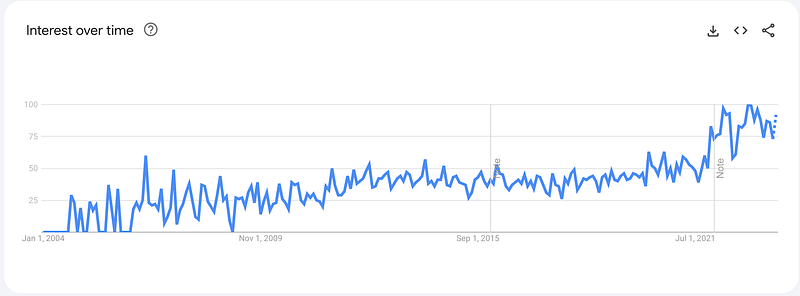 Google Trends showing the increase in search terms for “Dark Patterns” since 2004
As you can see in the above graph, the topic of dark or Deceptive Patterns has been growing over time. Thankfully, as our awareness of them has increased, so has the conversation about how we as designers should avoid using them.
Some common Deceptive Patterns that you may have come across are:
- Free trials that turn into subscriptions without a reminder
- Pre-ticked consent boxes to sign up for newsletters
- Making it more difficult to decline tracking cookies than just to click accept
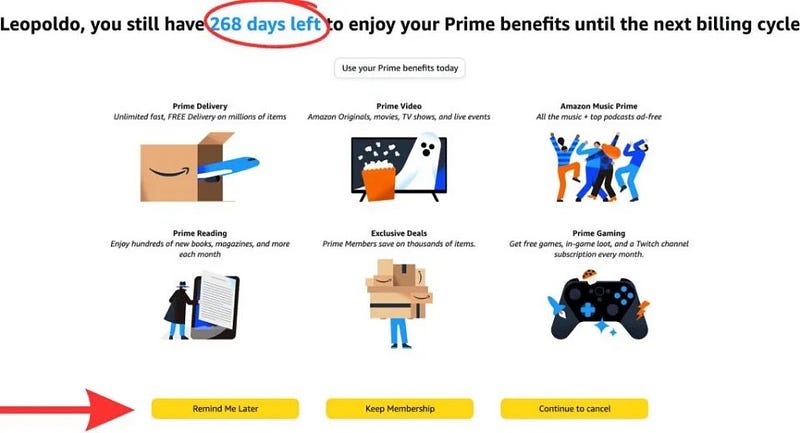 An example of Amazon trying to avoid people cancelling Amazon Prime
Amazon has been in trouble with the FTC in recent years over trying to prevent customers from cancelling Amazon Prime membership. The screenshot above used to appear when a customer wanted to cancel their membership. It not only highlights how long you’ve got left and reminds you of the benefits you’d no longer have access to, but it presents 3 buttons to choose from; Remind Me Later, Keep Membership, and Continue to Cancel. This is one example of the many ways they tried to make it difficult to cancel your membership.
These aren’t exclusive to digital experiences either, they can appear across a wide range of services and experiences. As you increase the scope and channels of an experience, you also increase the different ways that you can influence people’s decisions, whether it’s how you design a website, structure an automated phone menu or an in-person conversation.
As someone who studied Psychology before getting into the design industry, this reminded me of Behavioural Nudges.
Behavioural Nudges and Ethics
The concept of Behavioural Nudges comes from Behavioural Psychology. It proposes that by carefully designing the ways that people make decisions (the “Choice Architecture”), you can influence the outcome of that decision. Very similar to how Deceptive Patterns are used.
Behavioural Nudges have been around in Psychology since the 90s but were largely popularised by the book Nudge by Thaler and Sunstein, and influenced the establishment of the UK Government’s Behavioural Insights Team (informally called the “Nudge Unit”).
![A screenshot from a British government website showing a press release, which states: How a small nudge is helping people save for their retirement
In October 2012, the Government began introducing a groundbreaking new policy to automatically enrol people into workplace pension schemes.
“[This is] a new dawn for pension savers, with millions more workers being helped to save towards a pension with contribution from their boss” John Cridland, Director General of CBI](/assets/blog/vqdjtp0GHK-vaUYYQuv3Vw.png) A government press release announcing the new automatic pension enrolment policy
A government press release announcing the new automatic pension enrolment policy
This has influenced policy thinking in a range of ways, such as automatic opt-in pensions and organ donation, or using social norms to increase tax payment compliance.
In their book, Thaler and Sunstein also coined the term “Libertarian Paternalism”. This is the idea that organisations can influence people’s decisions and behaviours, whilst also providing people with freedom of choice.
It’s not just about using insights about human behaviour to influence how people make decisions, but also ensuring they still have the freedom to make their own decision if they disagree.
Although there’s still on-going debate about the effectiveness of different techniques, it clearly raises ethical questions about where and how much you should try to influence different decisions and behaviours. When studying this at university, there was a huge emphasis on ethics in this space. I can’t say it provided clear yes or no answers, but it made us all very aware of the responsibility that should go alongside this.
I think it’s this emphasis on ethics and freedom of choice that might differentiate Behavioural Nudges from Deceptive Patterns, but the lines are definitely blurry. Many Deceptive Patterns don’t entirely take away freedom of choice, just make it very easy to miss or forget that you do have a choice…
Deceptive Patterns in Organisation Design
I was recently reflecting on how Nudges and Deceptive Patterns appear in both digital product and service design, then began thinking of how it could extend further into Organisational Design.
As I mentioned above, Deceptive Patterns in digital experience are limited to the interface you’re interacting with, and in services this becomes more complex because it could happen across a range of interactions or touchpoints in a journey.
For organisations, this could become even more complex again because of the numerous different ways that you can interact with or be influenced by an organisation that you work for. Interactions with your manager, with your team, the tools you use day-to-day, the policies that govern how the organisation functions, there are so many factors to consider.
This has triggered a lot of different questions for me. What do these look like in an organisation? How can we identify and recognise them? If we’re going to be intentional about how we design organisations and do it in a people-centric way, what are the patterns we need to avoid?
There are also a lot of aspects of how organisations function that are so ingrained into our idea of what “normal” looks like that it might not always be easy to step back and think objectively about where Organisations might be influencing behaviour or to find patterns that might be reinforcing human biases.
Based on my own experiences and working with clients, I’ve started capturing some possible examples of deceptive patterns in Organisational Design in the hope of raising some awareness and triggering some conversation, and eventually possibly creating a tool or framework to better identify or mediate them.
Not publishing salaries and bands
This is one that came to mind quickly. Not publishing salary bands has a huge impact on influencing behaviour and outcomes.
If you put a positive spin on it, by not publishing salaries or bandings, you could avoid people feeling put off applying for a job if they think it’s out of their reach. It can also avoid possible jealousy or frustration between employees who are paid different amounts.
However, from a deceptive pattern perspective, the organisation is purposefully withholding information as a way to influence how individuals or groups talk about pay and reward.
This not only can make it more difficult for people to negotiate or push for a higher salary but can lead to a culture where discussions of salaries and earnings are prevented.
This puts significantly more power in the hands of the organisation compared to individuals by withholding information that could inform their decision-making.
Hiring for “cultural fit”
This is one that became a big topic of conversation at a previous company I worked for and eventually led to us changing how we approached attracting and hiring people.
As an organisation, we were very proud of the culture we had developed, that we were able to recruit from our networks without having to advertise and we wanted to hire more people who would help grow that culture.
However, we realised that hiring for cultural fit has a major downside, especially if you’re drawing from your own social networks. You just end up hiring a lot of people who think, behave or look like you do.
Given that culture is so heavily influenced by those who lead an organisation, this also gives them a major influence over the type of people that get hired into an organisation, whether intentional or not.
This could be seen as equivalent to Social-Proof, where people look at the teams/people around them and use that as a metric for what good looks like and therefore hire more people like that or behave in that way.
Asking what reasonable adjustments people want
In the UK, the Equality Act of 2010 requires that employers and service providers make ‘reasonable adjustments’ that allow disabled people to access the same opportunities and services as non-disabled people.
To be clear, this is a good thing for many reasons and I’m not saying that this is bad.
However, a lot of Organisations’ response to this is to ask new employees what reasonable adjustments they’d like, rather than providing a list of what’s available or information on what is already provided to employees.
This puts the responsibility on disabled employees to spend time and effort finding out what might be available and what they’re entitled to, at the same time as trying to settle into a new role in a new company. This is at a time when they may not feel secure enough to do that, and they’re likely on a probation period and won’t have established a support network yet.
This can benefit the Organisation because it can reduce the number of requests they’re getting for reasonable adjustments, which could require additional costs or time to put in place.
By offering information on what’s possible, available or where to find this, Organisations could give employees a lot more freedom of choice and better support.
Slow or difficult processes that maintain organisational inertia
I’m sure we’ve all experienced those processes at work that you just don’t want to have to deal with because they’re too complicated, confusing or convoluted. It could be filing expenses, adding suppliers, or requesting changes to working hours, but they can all be a pain when you find them.
I always find it interesting to look at which processes organisations focus on making quicker and more efficient vs which ones tend to get lower priority and don’t get improved. The way these are prioritised can directly influence how employees make decisions in a way that can benefit an organisation’s priorities.
When we talk about designing the “Behavioural Architecture”, part of that includes how much friction you can add or remove to influence behaviour. If you can remove friction, people are more likely to do something. If you add friction, they’re less likely to do it.
For organisations, if there’s less of a priority given to getting expenses repaid or requesting reduced working hours, these processes will be slower or harder to use, and therefore people will be less likely to use them. If you prioritise them because it’s what the organisation values, then they will get improved and that’ll make it easier for people to engage with.
This can be a really powerful way of showing the difference between the values an organisation claims to have publicly and the unspoken values they actually have day-to-day.
Just scratching the surface…
Deceptive patterns in organisational design can have a significant impact on employee behaviour and outcomes, and these examples are just scratching the surface. By recognising and addressing these patterns, we can create more ethical and people-centred workplaces.
In our design teams, we’re increasingly talking about Design Ethics and avoiding intentional consequences of design. We should be taking the same considered and intentional approach to designing organisations as we do for everything else. By raising awareness of these patterns, we can work towards designing organisations that are fair, equitable, and supportive of all employees.
I want to keep exploring this space and I’m keen to hear from others about where they’re seeing things like this, but also ways we can get better at identifying them. Please share any ideas or examples you’ve come across, or if you just want to chat about it and bounce some thoughts around.