GenAI in CX: Choosing when and where to use GenAI
Generative AI is the hot topic of the moment and it’s being talked about everywhere. Customer experience in particular is a big area for…
GenAI in CX: Choosing when and where to use GenAI
Generative AI is the hot topic of the moment and it’s being talked about everywhere. Customer experience in particular is a big area for this, with lots of opportunities and opinions on how the tools can create transformative experiences for customers. It can feel overwhelming thinking about the possibilities and where you can use them best, so how do you decide where to use them?
I wanted to share some early reflections in this space that can hopefully help you make more informed choices about how and where to use GenAI tools when designing end-to-end services and experiences.
I’m sure many of us are feeling the pressure to find places for this technology. It can be appealing to business leadership because it fits with the “do more with less” ambitions of a lot of organisations as they feel the dual pressures of trying to be more cost-efficient whilst also offering more to customers in the seemingly endless race for growth.
I won’t be talking about copyright and ethics issues in this blog post because that’s a topic big enough for its own post entirely.
GenAI has a lot of potential, but it’s not without problems
Before I get into talking about the strengths and opportunities of GenAI, I want to address some of the challenges and shortcomings of tools that use it. They’re not a magic wand with only upsides, and you should consider where to use them.
Firstly, these tools can be expensive. Subscription costs, API costs, computation costs, all of these can rapidly increase as you lean on GenAI tools more, and if this is done across an organisation in silos, it’s not easy to see this happening until you’ve already received the bill.
The reason for it being so expensive leads to my second point, energy usage. In a world where energy costs have been increasing, this can be a big factor to consider. GenAI tools can be very energy-intensive, and therefore also carbon-intensive.
Increasing use of these tools can lead to an increase in energy costs and an organisation’s carbon footprint, but even if you’re cognizant of that it isn’t always easy to manage.
There’s not a lot of information out there on the exact energy consumption of GenAI tools. The major companies involved are tight-lipped on this kind of information, but thankfully there have been some articles published about it.
Sasha Luccioni from Hugging Face recently conducted research in this space, looking at how different types of GenAI tools consume different amounts of energy.
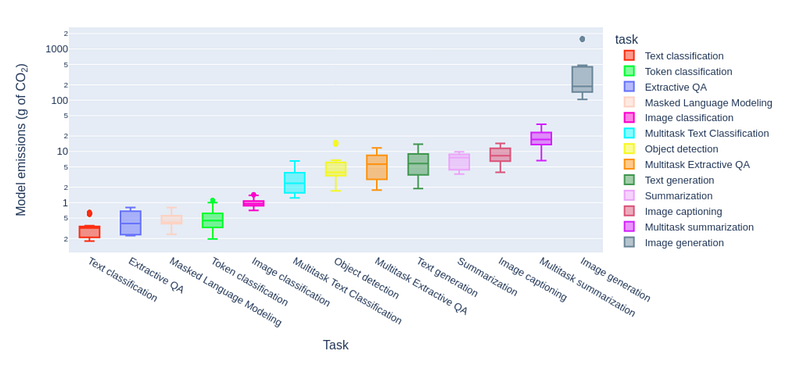
In this graph, you can see a range of GenAI tasks along the horizontal axis and the associated grams of CO2 emitted when running that task 1000 times.
Text classification, where GenAI comprehends text so it can be understood, uses relatively little energy at 0.002 kWh per 1000 repeats. Like streaming about 9 seconds of Netflix.
Text Generation is a bit more energy intensive at 0.047 kWh per 1000 tasks, or about 3.5 mins of Netflix.
As you get more complex though, energy usage goes up. Image generation came out at about 2.907 kWh per 1000 tasks. That’s roughly enough to charge your phone about 1000 times.
1 image = 1 phone charge.
Recently the NBA presented an experiment using GenAI to make basketball games appear in the style of your favourite films in real time. They used it to make a game look like the recent animated Spiderman films.
There’s been no word on energy usage, but we can all imagine the energy and carbon costs for tech like this are… pretty high.
And all of this is if you use an existing model. If you decide you want to train your own model, the carbon footprint increases dramatically. Training Meta’s LLaMA is estimated to have released 173 metric tons of CO2. That’s about 22 homes, for an entire year(according to this handy EPA calculator at least).
There are ways you can manage this energy use and cost that I’ll come back to later, but it is something you should be aware of.
Identifying where GenAI can be impactful
Now we’ve got that context, let’s take a look at how we can find the best moments to use GenAI in CX. As a technology, it does hold huge potential for creating better experiences, but it’s not always easy to know which moments to focus on.
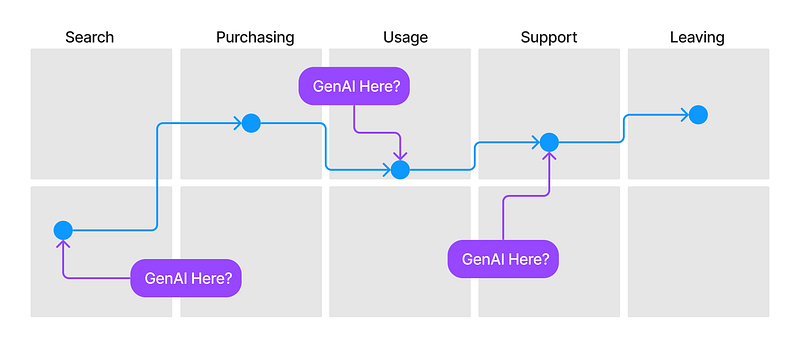
Based on recent projects, conversations and reading, I’m starting to develop some key questions/factors that you might find useful to keep in mind when trying to identify these moments.
The first question you want to answer is “Which moments are good opportunities for GenAI?”.
Hyper-personalised moments: Are there parts of the experience that call for individually personalised moments? Will users benefit from interactions that go beyond tailoring content to a segment, by offering a 1:1 experience? GenAI has huge benefits here because it’s able to quickly identify individual users and their preferences, understand any available options and tailor content.
Bespoke responses: Do you need to give users tailored responses, that are going to be different for each user or query? Robotics and automation can give quick responses, but if responses need to be different every time, GenAI is a tool you might want to consider.
Human language input: People speak and type in lots of different ways, unpredictable ways, and you can’t always ask people to use buttons and drop downs. GenAI can be good for understanding language and interacting with digital systems.
Humanising interactions: On the flip side, lots of us have experienced frustrating chatbots and automated voice menus that just don’t sound human and are different to engage with. GenAI (when used well) can help make these moments feel more natural.
Handling complexity at speed: Do you need to quickly process complex information? Humans are great at complexity, automation can work quickly. GenAI can be a great tool for doing both together.
Content creation: This is the one that people often jump to first, trying to create text, images, video, and virtual products. The speed at which GenAI can produce this is unparalleled, although the quality can vary. Being able to automatically create content based on a user’s input, or typing in a brief for an immediate response just hasn’t been possible before. The potential impact of this on customer experience and retail is huge.
This is just an initial list of areas, as technology continues to evolve and we find new ways for it to interact with people and tools, there are bound to be new experiences that can be created.
But… Is GenAI the right solution?
Now that you’ve worked out moments where GenAI could be used to create a better experience, the second question you want to answer is “Is GenAI the best solution for that moment?”.
Just because it could be useful doesn’t mean it should be used.
Is this a stand-out moment? In Service Design and at frog, we often talk about Moments that Matter or Signature Moments. These are the moments that are impactful for users and can really lead to delight. Is this an opportunity to create a stand-out moment that people will love and can be really meaningful? If this moment of the journey isn’t actually that important, it might not be the best place to use these kinds of tools.
Do people want real human interaction? Sometimes people want genuine human interactions so that they can feel listened to and acknowledged. These expectations may change over time, but if you use GenAI when people don’t want it, even the best implementation will have a negative impact.
Would empowering your people be better? Sometimes GenAI is looked at as a tool that can replace people (Remember “do more with less”…), but rather than replacing people, it can be more powerful to give employees access to GenAI tools. This can help them spend less time on administrative tasks or searching for information, so they can focus more on building a rapport with people, co-creating with customers, and elevating the experience.
Does it support your values? If your organisation values people, human interaction or relationships, putting lots of GenAI tools in place could be perceived as putting up a wall between people. If you’re closing down call centres to be replaced with GenAI chatbots but your values are about human contact, it’s not going to be a good look.
Does it foster trust? Trust is a huge topic for businesses at the moment, and this is only likely to grow as we use GenAI tools more. How do we know that businesses have our interests at heart? What data is being captured? How is it being used? Because GenAI tools often aren’t transparent, you should consider if using them will help foster trust.
Does it need to be Generative AI? GenAI is good for lots of tasks, it can do a lot, but it’s not the best for everything. There are non-generative AI models that can be significantly more energy-efficient for tasks like analytics or data capture.
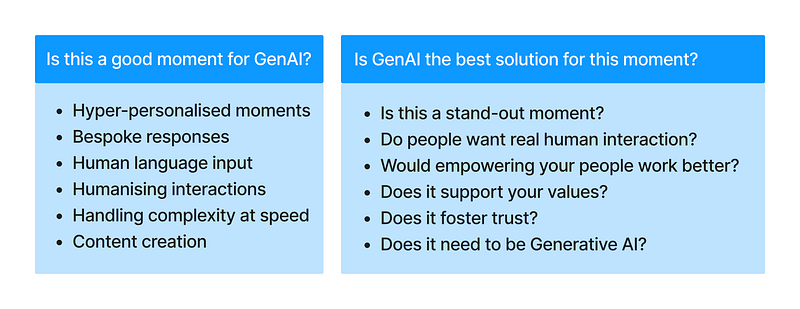 A summary of the key moments for GenAI tools, and the questions to check if it is the best solution
This isn’t to say you should avoid using GenAI tools, they have so much potential for creating better, more accessible services and experiences. Over the next few years, I expect that it could transform services in ways we can’t predict.
These questions will hopefully help you focus on the moments where GenAI can be most impactful for your organisation and the people you engage with, while also avoiding some of the unintended consequences.
Finally, when you are using GenAI tools, there are some things you can do to reduce the energy and carbon impact.
Reducing cost, energy use and carbon impact when using GenAI
How you implement and use GenAI tools can have a big influence on their cost and energy use. Here are some quick considerations that can help you get the best out of GenAI tools whilst also reducing these costs.
Try processing at times when energy is cheaper: The amount of renewable energy available and the cost of energy varies throughout the day. Do you need to use GenAI tools at that exact time, or could you run the request when costs are lower or renewable energy is available?
Are you using the most efficient model? Not all GenAI models are the same. LLMs are quite energy-intensive, and there’s growing interest in small language models that have fewer parameters but are more energy-efficient.
You probably don’t need to train your own model : Unless you’re in a huge company with specialist needs, need to train a very specialised GenAI model, or you’re a GenAI company trying to keep ahead of the curve, you probably don’t need to train your own model. If someone does start suggesting this, it’s definitely worth double-checking…
Hopefully, you’ve found this useful or interesting and it can help you bring some clarity and focus to where GenAI can have the greatest impact on the experiences you’re designing while finding ways to use it more sustainably.
This is a rapidly evolving area with lots of different perspectives and opinions, and I’m sure my own views will keep changing as I learn and experience it more. Let me know if you have any comments, builds or questions, happy to be challenged and to learn from others.