Affordances and beyond: Shaping Mental Models in a Digital World
When trying to design better experiences, services or organisations, it’s important that designers and the people we work with understand…
Affordances and beyond: Shaping Mental Models in a Digital World
When trying to design better experiences, services or organisations, it’s important that designers and the people we work with understand and have agency over the things we’re influencing. However, in an increasingly digital and intangible world, this is becoming harder.
In this post, I want to explore why this happens and how we as designers can address it.
A common challenge when designing intangible things like services and organisations is when peoples don’t have an accurate mental model of the things we’re trying to design, making it difficult to make informed, impactful decisions.
Sometimes this can cause minor annoyances, like when it’s not easy to find something on a website because the navigation doesn’t work as you’d expect. Other times, this can have much bigger implications, like recommending new ways of working based on inaccurate assumptions.
When considering how people shape their internal mental models, it’s often helpful to begin with Affordances.
Affordance is a property or feature of an object which presents a prompt on what can be done with this object.
The common example is a door handle. When you approach the door, you can see the handle and that tells you that you can grip the handle to open the door. Alternatively, there may be a flat metal panel that tells you that you can push there to open the door.
These have been known about for a long time in physical design, but it also translates into digital design. The placement of buttons indicates how you interact with them, and the way you navigate through an interface conveys the app’s underlying structure.
I was reading an article a while ago about university student that had grown up using search functionality and how it was shaping the way that they understood computers. Professors were finding that because these students had become more reliant on search to find things, they didn’t understand how the underlying file structure of the computer worked. This made it harder for them to understand where to find, store or access documents they needed for their course.
Students who grew up with search engines might change STEM education forever
Modern college students aren’t organizing their files into folders and directories, forcing some professors to rethink… www.theverge.com
This example shows that in digital experiences, the appearance and interface do more than just guide user interaction — they actually shape users’ internal mental models of how things work beneath the surface.
Moving beyond skin deep Affordances
Affordances communicate how you use and interact with something, but underneath that there’s another layer of understanding. I’ll refer to these as Affordances+, which communicate how something works and can be influenced. (Someone please tell me if there’s already a word for this…).
For simple objects, this is relatively easy. For example, by looking at a pair of scissors it’s very it easy to understand how it works. If you want to repair it or make a pair that worked for someone left-handed, you could easily do that because you easily understood the principles of how it worked based on how it appeared. The more easily we understand it and more predictable it is, the easier it is to influence.
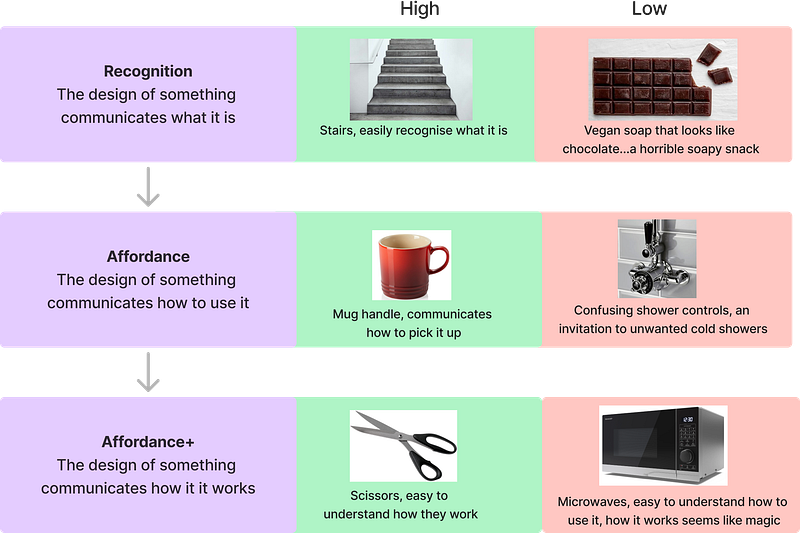
Understanding how and why something works the way it does is a key part of being able to influence and shape it. However, as things become more complicated and intangible, it also becomes more difficult to recognise and understand how something functions.
Scissors are easy.
A motorbike is harder.
Digital services, large organisations? Pretty difficult.
Affordances+ in intangible experiences
When people interact with intangible things like services and organisations, they don’t have the same physical or visible references they can get from a physical object. You can’t pick it up, take it apart and try to understand it in the same way. This makes it more difficult to create accurate mental models of how they work, which as we’ve seen from the university student example above can have a major impact on people’s ability to use and influence things.
This can also be seen when looking at how people respond to the increasing impact of ambiguous “algorithms”.
In search and social media, the information we see and how its presented to us in increasingly influenced by algorithms, however the details of how exactly these algorithms work are often kept secret from users as a way to maintain competitive advantage. Because the workings of the underlying algorithms are obscured from users, we can’t directly understand how to use it to our benefit, or how we can influence it.
In response to this, marketers and social media creators will often try to probe and understand algorithms by seeing how well different types of media or content perform. They’ll have a mental model of what they think will work well, they can then test this and adapt their mental model based on the results. This is an indirect way to map the algorithm and how closely it aligns to mental models.
Building on this trail of thought, I began thinking of Affordances+ not just as being either high or low, but as a spectrum from aligned to contradictory. If some experiences or interfaces closely align with how the underlying system functions and some are ambiguous, it’s also possible that they could be contradictory to the underlying system.
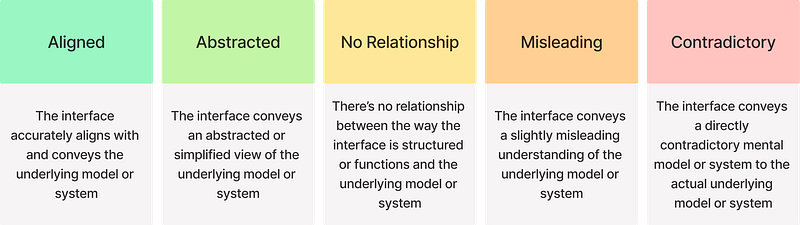
This means that not only can the interfaces and experiences we create make it difficult to know how something works but could actively mislead people.
How can people effectively change things if they can’t understand it?
Confusion, obfuscation and agency
I often work with teams to change and co-create a better future state, designing new services, processes and organisations. To do this, both my team and the people we’re co-creating with need to have a good understanding how and why things currently work the way they do. People can often have different mental models of how and why things happen, making it even more difficult to collaborate on solutions.
In Organisational Design, people’s mental models are increasingly being influenced by the digital tools they use to interact with the organisation and people around them. Often companies with use digital HR platforms like SuccessFactors or Workday to communicate information to employees and manage processes and this becomes the lens that people use to understand the organisation.
When designing interactions in organisations, there’s often a huge emphasis on simplifying processes and driving efficiency. This is often beneficial to users and the organisation, but by over-simplifying it can actually hide how the organisation really functions behind the scenes. This can obscure the realities of processes, decision making, power dynamics and even team structures within the same organisation.
Think about when you’ve had to raise and HR or IT support ticket. You fill in a form, click send and you wait.
If you don’t hear back, who can you contact to escalate? How long should it take? If there’s a problem, how can you suggest a way for it to work better? It can become a bit of a black box that should function well, but you don’t know how and can’t easily work out how to improve it. This often leads to people relying on their own assumptions and can be very frustrating when things don’t work as expected.
If tools and interfaces obscure or mislead how the organisation works, that not only makes it harder for people to understand how to interact with it, but it reduces peoples’ ability and agency to influence the organisation around them.
This isn’t exclusive to organisations. If you consider the increasing digitisation of public services and government, these will also shape people’s mental models of how to interact and influence government and public services.
Through the shaping of interfaces and services, the underlying systems and workings can become obscured or could even purposefully mislead citizens. This would make it much harder for citizens to make informed decisions about what they want to change or how to influence them.
The tempting trap of simplicity and GenUI
The development of increasingly perfected, simple interfaces is a common driver in design, we want to make things as easily as possible for people to interact with.
As tools like ChatGPT, Google Gemini and Claude have taken off, these have rapidly become a common interface for answering questions, interacting with services and accessing information of different types. There’s obviously benefits to just being able to ask questions and quickly being presented with an answer that’s easy to understand and tailored to your needs. However, the simplicity of these responses also hides how these tools work, and how information can be found and structured. This already takes some steps towards obscuring the underlying structures or systems involved.
Moving even further, in recent months both Nielsen Norman and Andreessen Horotwitz have touched on using GenAI to change how we design graphical user interfaces, and have suggested a route towards “Generative UI”. The idea is that rather than having user interfaces that are designed and then used by everyone equally, GenAI tools would enable us to generate personalised interfaces for each individual based on their needs and preferences.
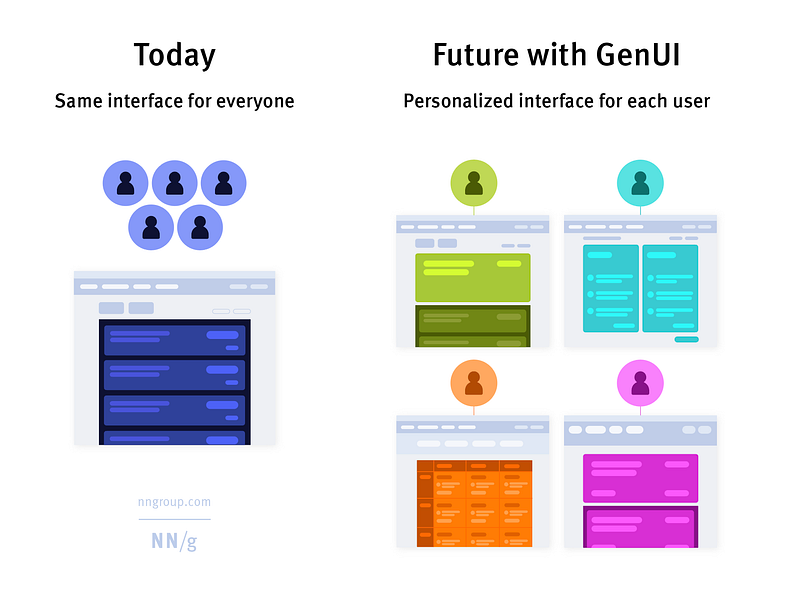 An illustration of the difference between interfaces today and a Generative UI, from Nielsen Norman
This could lead to a further disconnect between the interface being presented and the underlying systems. If the interface adapts to the user’s needs and preferences, rather than on a common representation of the underlying systems, it could over-simplify the experience. It could even adapt to a user’s incorrect and assumption based mental model and create an interface that reinforced their assumptions.
On top of that, because the interface may be different between users, it could be more difficult to develop a shared view or understanding of the underlying systems.
If we don’t think carefully about how we use and interact with GenAI tools, it could become an increasingly influential tool that obscures how the systems, organisations and services around us actually work.
When designing GenAI-driven interfaces and services, there’s already some helpful work started. For instance, Projects by IF have started developing suggested AI Design patterns, which can be found here.
Why this should matter to designers
As designers, we’re lucky that it’s part of our job to take time to research and understand how and why something works, we go through a “sense-making” process to consciously build our mental models.
However, most people are busy and just want to get things done, they don’t have the time to explore and pick apart why something works the way it does. This reduces the time and effort they have to accurately create or challenge their mental models.
They shouldn’t have to spend time doing that.
Through the things we create and the ways we work with clients, designers should strive to make it easier for people to build accurate mental models of the world around them, increasing their agency to influence it.
So, what can we do in our projects to help people understand obscured systems, and shape solutions that are more transparent?
Researching vs Sensing and responding
Research is a hugely important part of projects. It helps us understand, map, prioritise and shape things. However, the way we approach this should vary depending on the problems we’re facing.
At university, I came across the Cynefin Framework developed by Dave Snowden.
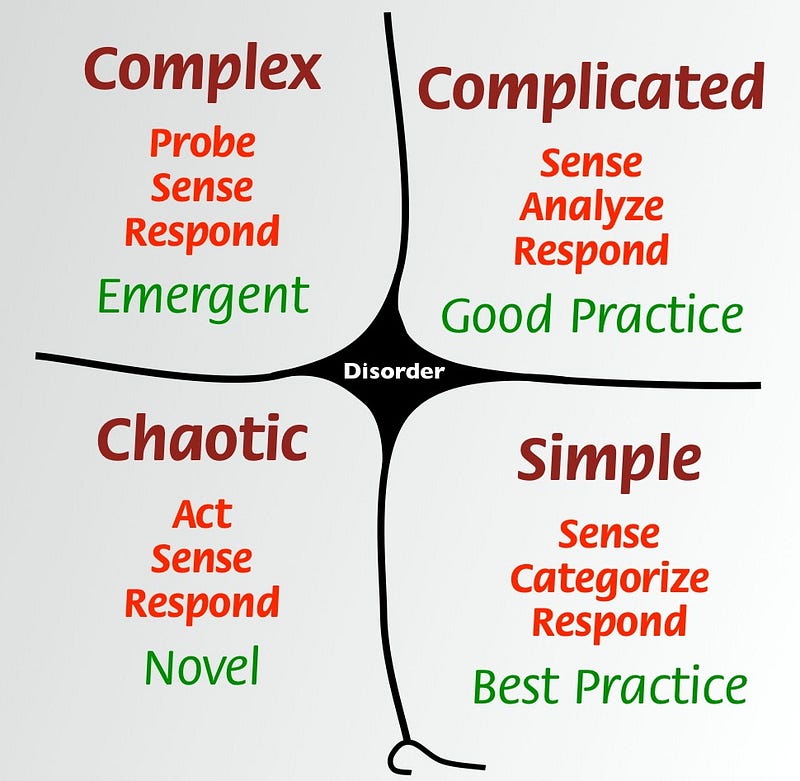 By Snowden — File:Cynefin framework Feb 2011.jpeg, CC BY 3.0, https://commons.wikimedia.org/w/index.php?curid=53504988
The Cynefin model describes how we understand and influence different systems based on their nature: simple, complicated, complex, or chaotic. There’s extensive literature on this, so I’ll focus on complex systems.
For complex systems, it’s not always possible to develop an effective understanding from just sensing and analysing because the underlying system is complex or obscured from us. At times like this, rather than conducting passive research, it may be important to actively probe a system and see how it responds, similar to marketers trying to understand a hidden algorithm.
In projects, this could include launching experiments and prototypes early to see how people and systems respond so that you can learn more, rather than conducting a large amount of up-front exploratory research.
Don’t shy away from complexity
If we want face into and work on some of the most complex problems, like regenerative solutions, people centric organisations or new government services, we can’t shy away from complexity. We need to embrace it.
This can often involve working at a scale that we’re not used to, using large amounts of data and information and mapping big, complicated systems.
This is where we can lean into digital tools or AI to help us. Tools like kumu.io can be helpful for mapping complex systems, AI tools can help us analyse large amount of data quickly. This can be intimidating but can also be a huge asset if we want to maximise the impact we can have.
Understand and communicate
As I said, we’re lucky in that we get to spend time actively sense-making, but our clients and stakeholders don’t always have this opportunity. To be effective designers, that doesn’t mean it should be on us to develop the ideal solution and just hand this over.
As part of sense-making, we should be sharing, communicating and collaborating with clients and stakeholders. They will have knowledge and expertise, they can challenge and build on our understanding, and will then be more empowered to influence and shape the solution.
Putting effort into creating materials that make it easy to understand insights and setting up rhythms for regularly sharing and capturing feedback is hugely important in doing this effectively.
When working on complex systems, we need to also make sure we’re not overwhelming people with information. It’s part of our job to effectively synthesise our understanding so we can help people understand what’s important and bring focus to key areas. This is why tools like Customer Journeys are so useful, they’re tools that make it easier to communicate complex topics and build a shared understanding.
Simplify interfaces, don’t mislead
I think it was in John Maeda’s book “The Laws of Simplicity” that he talks about the importance and power of design in being able to articulate the importance and complexity of systems whilst making it simpler to engage with. We have a responsibility to make sure that we’re not over-simplifying or misleading people.
When creating interfaces and services, yes, we should try to make it easier for people interact with them, but we should also be careful to support their comprehension and avoid misleading them about the underlying systems involved.
- Create interfaces and layouts that align with and communicate the information architectures or underlying systems.
- Consider how the information architecture communicates the underlying systems or teams.
Active transparency
Users often don’t have the time, so we should put the effort into actively providing information they might need. We should make an effort to be transparent, not leave information in an awkward FAQ, or just explain things if someone asks.
- Be transparent about what happens in the background to set users expectations and increase their understanding. Little explanations or tooltips can easily add context, particularly if relying on interfaces like chat that make it harder to understand
- Show steps that don’t involve the user. This makes it easier for people understand why things are happening at the speed they are, and can make it easier to ask directed questions if they have them
- In organisations, make useful documents and information visible and actively share them. Putting them in word documents or powerpoint slides on a sharepoint that people struggle to find isn’t going to help until someone is really hunting for information.
This is just the start of some of my thinking, I’m actively exploring tools to map and communicate the underlying systems and dynamics in services and organisations so that we can better understand them and make more informed decisions when designing. If you’ve seen something you think that makes this easier, or want to bounce some questions around, let me know.