Persona and role cards
Distinct persona cards (who a person is) and role cards (what they're trying to do), designed to work together rather than blur into each other.
Most persona work collapses two things together: who someone is, and what they’re trying to do in a given context. The result is personas that can’t be reused across journeys, because the role is baked into the identity. There’s a subtler problem too: when you describe a field engineer’s attitude to technology or personal motivations alongside their job responsibilities, you start implying that people who hold that role tend to look a certain way. Different people hold the same roles, and blending the two pushes design teams towards stereotyping that good research is supposed to prevent.
These two card formats separate them deliberately. A persona card describes a person’s context, background, and perspective. A role card describes the responsibilities, tools, and needs inherent to a particular job or function, regardless of who holds it. The same persona can carry multiple roles simultaneously: a manager who is also a learning and development lead, a customer who is also a business account holder. The same role can be filled by different personas, each navigating it differently.
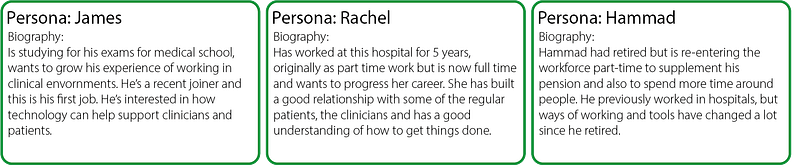
Bringing the two together creates a third thing: a pairing. Where a specific person meets a specific role, emergent insights appear that neither artefact surfaces alone. How their background shapes the way they approach a task. Where their personal context creates friction, or unexpected capability. These pairings are where the design work actually happens.
The cards were developed in the context of employee experience and organisational design work, where the distinction between the person and the job is most consequential. They’ve since proved equally useful in service design contexts, wherever a team needs to reason about who someone is and what they’re doing at the same time, without flattening one into the other.