Designing for Employee Experience vs. Customer Experience: Differences and Tips for Success
Through the lens of Service and Experience Design, designing for Employee Experience (EX) and Customer Experience (CX) may seem similar at…
Designing for Employee Experience vs. Customer Experience: Differences and Tips for Success

Through the lens of Service and Experience Design, designing for Employee Experience (EX) and Customer Experience (CX) may seem similar at first glance — they both reflect an organization’s brand and values. However, to create more impactful EX designs, we need to understand what sets it apart from CX. In this post, I’ll share key insights for designers venturing into EX, helping you craft experiences that better support employees, align with clients needs, and support a thriving workplace culture.
Two sides of the same coin
Working across service design and organisational design, I’ve spent a lot of time designing experiences for customers and employees, and they’re two sides of the same coin.
When crafting a Customer Value Proposition and a Customer Experience, these should be a reflection of an organisation’s brands and values. This helps differentiate the products and experiences they offer from competitors in the same space.
In the same way, your Employee Value Proposition and Employee Experience should be a reflection of the same brand and values. Being authentic to these values can help attract and retain talented employees, and in turn, makes it easier for them to share those values with customers.
Although they should be reflections of the same values and often use similar tools there are some important differences to consider when designing for employees and colleagues.
Personas, Archetypes and Roles
When designing Customer Experiences, it’s common to talk about Personas and Archetypes
Persona: A detailed, fictional character created from user research to represent a section of the target audience, based on behaviours, goals, and needs, aimed at guiding the design process with a user-centred perspective.
Archetype: A generalized, symbolic representation of universal human behaviours and motivations, used in design to understand and appeal to fundamental aspects of human psychology across various contexts.
These are core tools that help designers take a human-centric approach to designing experiences, and work well when you’re designing for customers. We want to understand and empathise with people’s inherent and underlying needs, motivations and pains.
However, we need to adapt our approach when designing for employee experience. People have jobs or roles that have additional needs, responsibilities and challenges linked to them. This adds another layer you need to consider when designing in organisations.
This doesn’t mean you should just combine Personas and Roles into one artefact. This is a mistake I’ve seen a few times. For example, a persona for an electricity field engineer that includes their responsibilities and skills, but also describes their personal preferences, behaviours, their age, their comfort with new technology, etc.
People aren’t the same as their jobs, and different types of people can have the same jobs. Combining these into one Persona blurs the lines between people and their jobs in ways that can at best cause confusion or at worst reinforce stereotypes and lead to bad design decisions.
You can do this by creating Role Cards that you can use in combination with Personas. This makes it easier to be clear on needs that are related to a person’s job or role, whilst also considering how different people might they perform it or the differing kinds of support they may need.
Role Cards: An artifact that provides a detailed description of the needs, behaviours, pains etc that are inherently linked to a person’s role of job, e.g. key responsibilities, rewards and motivations, activities and processes, tools and software, travel requirements.
For example, we could be working with a hospital, and as part of this be designing for the reception and administration team, so we could create a Role Card for a Clinical Administrator. (Obviously this is extreeemely simplified)
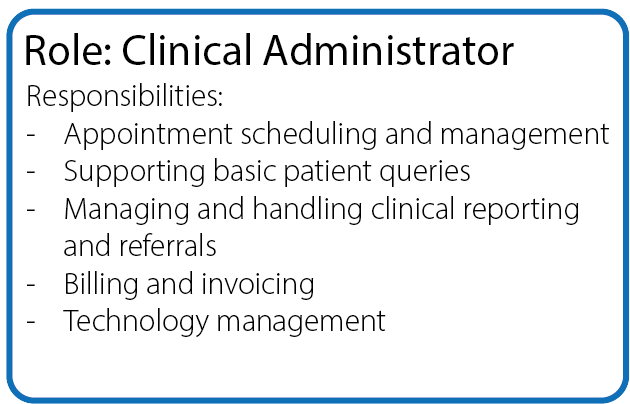
This can break down the responsibilities, needs, tools etc that are shared by everyone who is a Clinical Administrator at the hospital.
We can then pair these with Personas to then reflect on how different people might behave or act in this role, and how their needs might be different.
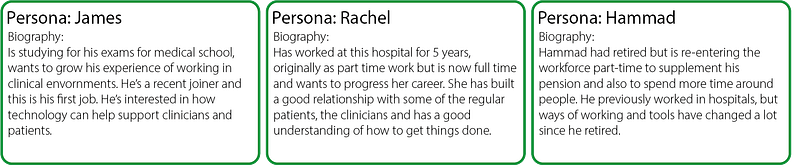
As you can see from these cards, each of the personas are different, and how this translates in their work life will also differ. By using a combination of Personas and Role cards, we can more effectively design for people and what they’re trying to achieve.
Much more involved and less linear
Unlike customer journeys, which are often straightforward, the employee experience spans diverse tools, interactions, and environments, creating a complex and non-linear ecosystem.
In CX, Customers often only interact with an organisation when they’re using a particular product or service, when they have a specific need they want to fulfil.
For Employee Experience, people often spend the majority of their days there, surrounded by their colleagues, environment and tools. This creates an experience that is much more holistic and much less linear. Throughout a working day or week, someone can do many different things, interact with many different people and be in many different environments.
This isn’t to say that a linear view isn’t helpful. Having a high-level view of the employee lifecycle can be helpful for understanding where in their career an employee might be, just don’t rely on it entirely.
I often find myself using Ecosystem Maps much more in Employee Experience projects. This is because of the high number of tools and people that someone will interact with in their workplace. Emails, Slack, HR portals, timesheet tools, managers, colleagues, mentors, HR advisors.
It can be a lot to navigate.
By mapping this ecosystem, it becomes a lot easier to make sense of it and to understand the value and the quality of the interactions in that ecosystem. It also makes it easier to see where you can smooth out pain points and make things more efficient.
Competing ownership across the journey
In customer experience design, there’s often a clear product owner with decision-making power. Employee experience, however, spans multiple departments, teams, and managers, each impacting the overall experience.
Although HR or a People Team might have the remit for setting a vision and have ownership of the HR aspects of the employee experience, they probably won’t control a majority of the experiences that people have at work. This could be owned by team leads, tech teams and a range of people across the organisation.
This means that rather than focusing on one or two key stakeholders, you’ll have to engage with people across the organisation so that they understand and buy-in to the vision and the value of improving the employee experience. If people don’t understand or care, they won’t help make it happen.
To help with this, EX designers need a collaborative approach. For example, engaging managers, HR, IT, and other teams from the start ensures that each stakeholder understands and supports the vision. Co-creation workshops and transparent communication can secure buy-in early, reducing resistance when rolling out solutions.
Designing for jobs vs designing for careers
It can be hugely satisfying and rewarding to create workplaces that support people, nurture talent and help people grow into their dream jobs.
But not all workplaces are that, not all jobs are peoples’ passions. That doesn’t mean you can lower your standards and create a low-quality experience, but it does mean you should approach it differently.
A few years ago, I was working with a retail logistics organisation to set an employee experience vision, develop concepts and set a roadmap for technology and non-technology change.
For some people, it was a job that they wanted to work up through, and get career development and progression.
For others, working there was good seasonal work that was there when they needed it. They weren’t that interested in staying there long-term and being part of the company.
Based on that, we developed different experience visions. For temporary workers, we focussed on enabling flexibility so that they could get up to speed quickly after being away and more easily choose shifts that suited their needs. It also benefited the organisation because really good temporary workers would keep coming back, rather than needing to train new people all the time.
Not everyone views their job as a lifelong career, and designing for employee experience means recognizing these different motivations. Instead of assuming all employees are looking for career growth, address real needs and respect the diversity of employee aspirations. When employees feel understood, they’re more likely to engage fully — whether they’re here for a season or a decade.
Configuration > Customisation
Finally, a point about software. To be blunt, lower your expectations. Internal tools rarely get the investment that customer facing software does, and most HR platforms are delivered by a relatively few well established companies.
Unlike customer-facing tools, internal systems are often limited in customization options, requiring designers to work within preset configurations. Investing too much time in custom interfaces can lead to diminishing returns. Instead, define what is needed, then focus on higher-impact areas, such as optimizing workflows, clarifying communication, and improving physical spaces — where meaningful change is often more feasible and impactful.
Employee Experience shouldn’t be under valued
Employee Experience doesn’t always get the same recognition and make not appear as shiny or exciting and customer experience work, but the impact can be huge and incredibly rewarding.
Yes, it’s work, and we all complain about it sometimes, but these are also people’s jobs, careers and livelihoods. You can have a huge impact on people, grow teams that can perform at their best and be more satisfied at work, and deliver the better customer experiences that we want to see.