Why your research disappears into the organisation
This is the second post in my series on design capability as a system. If you haven’t read the first, it introduces a framework for…
Why your research disappears into the organisation
This is the second post in my series on design capability as a system. If you haven’t read the first, it introduces a framework for diagnosing where your design function might be falling short.
There’s a pattern I’ve watched play out more times than I can count. A research team does solid work. They capture genuinely valuable insights, identify risks or opportunities that could shift the direction of the business. The evidence is strong. The story is compelling.
And then nothing happens.
From the research team’s perspective, the business doesn’t seem to hear or care. The work vanishes into a presentation deck that nobody references again. The opportunity passes. The risk materialises. And the people who did the research start to wonder whether any of it matters.
This isn’t just an organisational effectiveness problem. There’s a human cost here too. Researchers who repeatedly see their work ignored don’t just become less effective; they become disengaged. The sense that your insights don’t matter erodes motivation in ways that are difficult to recover from.
The gap between generating and landing
When I’ve dug into why this happens, I’ve found that the problem isn’t usually the quality of the research. It’s what happens between generating the insight and landing it with the people who could act on it.
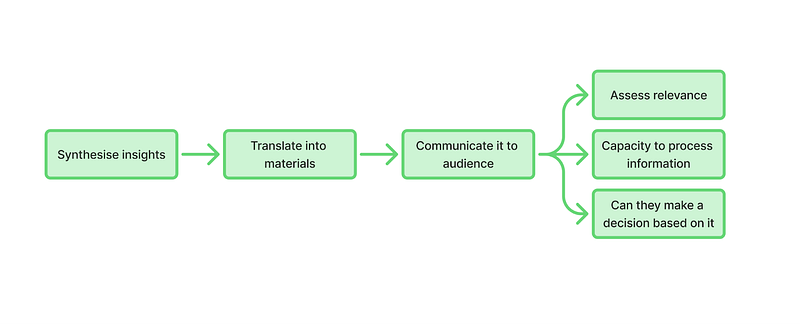
There’s a useful concept from systems thinking here: the Law of Requisite Variety. In plain terms, it means that to deal effectively with the complexity of the world around you, you need an equally sophisticated capacity to sense and respond. If your ability to understand what’s happening is limited, your ability to adapt will be limited too.
This sounds abstract, but it has practical implications. Design and research teams are often positioned as the organisation’s capacity to sense what’s happening with customers, users, and the wider market, but sensing is only half the equation. The other half is making sure that information reaches the people who can actually do something with it.
This isn’t a simple handoff. It’s a design problem in its own right: how do we create the conditions for the right information to reach the right people at the right time?
Where the connection breaks
In my experience, the connection between research and strategy tends to break in predictable places.
The channels simply don’t exist
The people who influence strategic direction may not be the teams research works with day-to-day. There might be committees, leadership groups, or functions that shape the business but rarely hear from research directly. If insights have to travel through multiple layers to reach decision-makers, they get filtered, delayed, or lost entirely.
Quick action: Map your current access. Who does your team interact with directly? Who do you reach only through intermediaries? Where are the gaps? You might find entire decision-making groups that research never touches.
The work isn’t connected to what leadership is wrestling with
Research driven by product teams will naturally focus on delivery questions. Even studies that sound strategic are often framed around validating decisions that have already been made. Direction-setting research, the kind that tackles questions the organisation might not know to ask yet, requires different positioning.
Quick action: Find out what leadership is wrestling with. This sounds obvious, but many research teams don’t actually know. Look at strategy documents, listen in town halls, or simply ask.
When doing this, keep in mind that there is sometimes a difference between a company’s visible, explicit goals or strategy and an unspoken, implicit strategy. Leaning into relationships you’ve developed can give you insight into what’s really on leaders’ minds, not just what’s in the official comms.
Sometimes insights arrive too late
Strategic decisions cluster around moments: budget cycles, planning seasons, leadership offsites. If research operates on its own cadence, disconnected from these rhythms, findings land after the relevant decisions have already been made.
**Quick action: Map when decisions actually happen. **Strategic decisions cluster around moments: budget cycles, planning seasons, leadership offsites, roadmap reviews. Some happen in formal settings while others happen in conversations you’re not part of. Work out your organisation’s rhythm, this is intelligence-gathering about the organisation itself.
The insight is there, but it lacks the translation work needed to land with a strategy audience
Different vocabulary, different frames, different levels of detail. A sixty-slide research deck is a delivery artefact, not a strategy artefact. The burden of translation often falls entirely on the research team, and it’s exhausting.
Quick action: Match the format to the audience. Strategy audiences want implications, options, and recommendations rather than methodology. One-pagers for busy executives, discussion guides for workshops, data points for business cases. These can also all be captured in digital formats, making it easier to handle the information directly, and you can even create templates for repeat audiences to reduce effort.
A different kind of design challenge
This isn’t about researchers just needing to be better at communication, though that does help. It’s about recognising that the flow of information through an organisation is itself a design problem.
How do we create channels that actually connect research to decision-makers? How do we help research teams understand what leadership is genuinely wrestling with? How do we build the relationships that allow insights to bypass bureaucratic filters when they need to? How do we time research so it arrives before decisions are made, not after?
These questions don’t have universal answers. They depend on your organisation’s structure, culture, and decision-making rhythms. But asking them shifts the frame from “why isn’t the business listening?” to “what’s preventing the connection from working?”
Starting somewhere
If you’re recognising this pattern in your own context, it helps to start with diagnosis rather than solutions.
Either yourself or with your team, pick a recent piece of research that didn’t land the way you’d hoped. Walk it through the journey: who did it reach? How did it get to them? When did it arrive relative to the decisions it could have influenced? What translation work was done, or not done?
Often the answers reveal specific points where the connection broke. That’s where to focus attention first.
Building these connections takes time. It requires relationships, not just processes. It means understanding how decisions actually get made in your organisation, which is rarely how the org chart suggests they should. It also means accepting that even excellent research won’t land if the system for delivering it isn’t working.
The good news is that small improvements compound. A relationship with one strategic stakeholder opens doors. One well-timed insight that influences a decision changes how the team is perceived. These aren’t overnight transformations, but they add up.
I’ve been exploring this question as part of a longer piece on design capability as a system, looking at why the functions that should make design effective often don’t work as intended. More on that soon.
In the next post, I’ll look at a different kind of system strain: the coordination exhaustion that comes from teams constantly context-switching and working in silos. If your people are busy but nothing feels joined up, that’s where we’re heading.
As always, if any of this resonates or you’re wrestling with these challenges, I’d love to hear from you.