Service Design Needs to Evolve. Here’s Where I Think It Should Go.
This post is about the future of Service Design, why I think the practice needs to evolve, and what we can practically do about it.
Service Design Needs to Evolve. Here’s Where I Think It Should Go.
This post is about the future of Service Design, why I think the practice needs to evolve, and what we can practically do about it.
Service Design has grown enormously over the last 15 years, but unlike Product Design, which transformed from web design through UI and UX into something genuinely new, Service Design has largely refined rather than reinvented itself. We’re doing what we did before, but better.
I don’t think that’s enough anymore. Design teams are under increasing pressure, AI is changing everything, and the challenges we face are growing more complex. We need new tools, methods and approaches.
I’ve been exploring four areas where I think this evolution needs to happen, and I’ve started building tools and methods to test these ideas. This post introduces each of them.
Weaving together business and design
An early lesson for all service designers is that businesses don’t speak the language of human centred design.
As design has fought for its “seat at the table”, we’ve increasingly had to find ways to articulate the business value of design. How can we take what we do in design and make it meaningful for CEOs, CFOs, strategy officers and more? Businesses understand growth, margin, customer retention, and we’ve become significantly better at developing KPIs and measurement frameworks that show impact as well as developing narratives that can tie into business strategies. Much like our own practice, we’re helping businesses do what they do, but better.
However, when I talk about weaving together business and design, there’s a bigger challenge that I think we’re struggling with, and it will not have a quick fix. How can we change how businesses think about what they do and the impact they have?
Businesses need to consider strategic risks, unintended consequences, social and environmental impact. These almost always aren’t about just carrying on as before, but about realigning a business around a new way of thinking and working.
As designers and researchers, we’re able to build a deep understanding of people and impact, but we need to be able to help organisations rethink and reposition what they do, and that means having different conversations and working with different teams.
I recently worked with an organisation in the energy sector with a major role in shaping the future of the UK’s energy system. I worked with them in shaping their customer understanding, their strategy and how they measure impact. A key learning of this work was moving them away from customer satisfaction as a metric to a new customer trust score. Their role depends on being able to foster strong, trusted relationships with customers. Even though they will sometimes challenge or even frustrate their customers, they need to foster trusted relationships. We were able to identify what it is that fosters trust for their Customers, and develop this into a new trust score and measurement framework that was agreed by the Board. This means they can prioritise projects differently, focus on different activities and have a different impact for their customers and the energy system.
For me, this is an important example of how our work as designers isn’t just about helping businesses hit growth targets, but about challenging them to think differently about the impact they should be having, and how they can be held accountable to it.
Another way that we can improve on this is by working with teams we often don’t get to, like strategy or risk teams. We often work alongside product teams or delivery teams, but some of these conversations about risk and unintended consequences need a different audience.
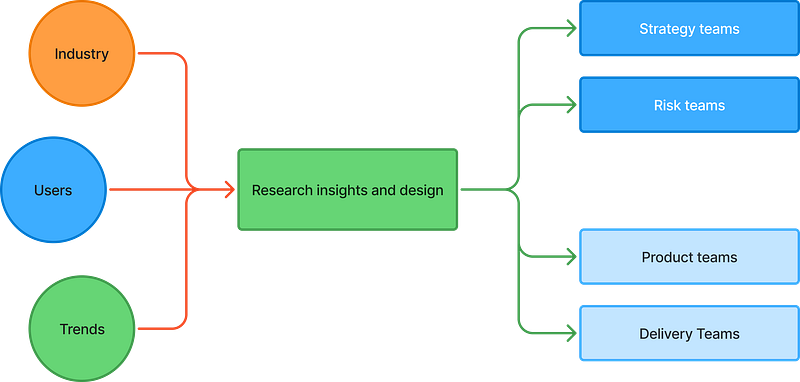
This doesn’t mean just getting a meeting with these teams, but thinking about how we translate our research or solution insights into materials or stories that make sense to their priorities and focus areas. Our insights are only useful if our audiences can understand them, have the capacity to process them, and the motivation to do so.
We can’t playback the same content that we would for a product team and expect them to see how it is relevant to them. We need to consider how we frame this content and insight that makes it easier for them to act on.
Designing for/with Complexity
For anyone working in Service or Organisational Design, complexity is never far away. We’re inherently designing intangible things, that involve lots of people and systems, with competing priorities and politics.
This is partly why tools like Customer Journeys and Personas have been so popular, they make something that inherently very complicated and intangible into something that easier for stakeholders to understand and empathise with.
But when we’re doing this work, I think we’re often at risk of either oversimplifying how we tell that story, or even oversimplifying how we actually do the work that we do. We can’t just rely on holding the complexity in our heads and using tools that simplify it, we risk reducing the quality of our work, making mistakes, and increasing unintended consequences. We need better tools for managing and designing with complicated or complex systems.
This doesn’t mean we need to start from scratch. Fields like Systems Thinking, Cybernetics, complex systems theory, and psychology have been studying these topics for decades, but we need to develop methods and tools that make this practical for Designers.
I’ve been exploring how we can use tools from other fields, like the Viable System Model for organisations or graph databases to develop new tools for designers.
We often think of services as linear experiences that go from start to finish, because that’s how users experience them and how we map them.
In reality, we know that a service is an ecosystem of people, tools, organisations, processes, etc that interact, and that a user’s experience is just one lens of how they interact with it.
I’ve been experimenting with how we can use graph databases to map the ecosystem, and how the different elements relate to each other, so that we can understand that ecosystem more effectively. This not only makes it easier for us to work with this information, but makes it easier for us to show the value of service or organisational design.
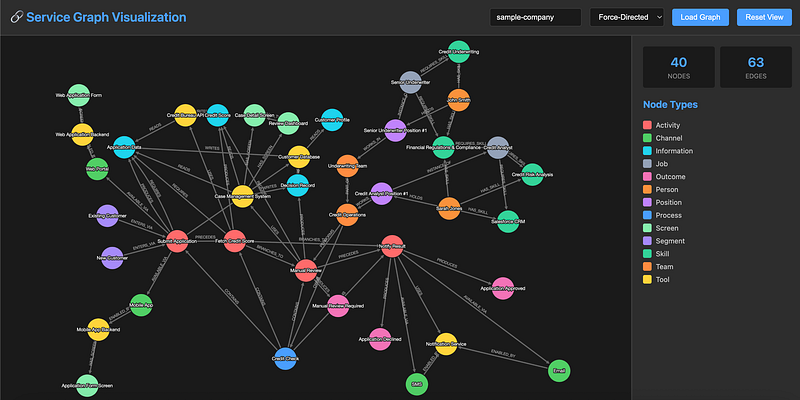
This is a view of just a small section of a service mapped in an early draft of a tool I’ve been working on. It looks complicated because it is, services and organisations are complicated. But by developing tools that work with this, we can leverage this information to our benefit rather than glossing over it.
If someone wants to know which teams or tools would be impacted by a process change, I can instantly get an answer. If we know a particular metric isn’t being hit, we can quickly see what activities contribute to it, or what teams and tools support it so that we can work with them to unpack the possible problems.
I’ve also been experimenting with being able to model how different personas would flow through a service so we can pre-emptively try to spot bottlenecks or unintended problems before they happen.
By leveraging information that’s often hidden in long process flows, standard operating procedures or internal surveys, this is rapidly turning into a powerful tool for expanding our understanding, as well as enabling us to more rapidly answer questions and gather insights.
Reclaiming time for what actually matters
With tools that can surface insights more quickly, we can start reclaiming time for what actually matters. Businesses are looking to maximise efficiency and reduce spending where they don’t see value, so we really need to make sure we’re spending our effort where it has the most value.
The value in service design is in:
- Understanding people, problems and their context
- Developing, testing and refining impactful solutions
- Working with others to make those solutions real
And yet I’ve seen people spend days in Figma or PPT refining and improving Personas and Journeys. This needs to be done because we want the quality of our deliverables to land well, just like a product designer needs their screens to be perfect. But a product designer’s screens are the product, they are what is built. For Service Designers, Journeys and Personas are a communication tool for a lens on a service. If we spend more time perfecting and polishing these deliverables, it can reduce the time we spend on where the value of service design really is; understanding people, problems and their context, developing solutions and working with others to make solutions real.
This doesn’t mean we should stop doing them, but we need to find new ways to do this that can save us time while not compromising on the content.
We all know that Personas and Journey are important documents for aligning stakeholders and communicating about the impact of potential changes, but they’re far from living documents. They get saved as a PDF, maybe printed, and then they’re often out of date in a few weeks and have to be re-done. And the information in them often needs to be manually copy and pasted into other documents.
Born out of this frustration, I’ve been working on how we can develop standard data formats for Personas and Journeys that we can quickly review, update, enrich with data, and then import into tools like Figma, PPT etc as and when we need to.
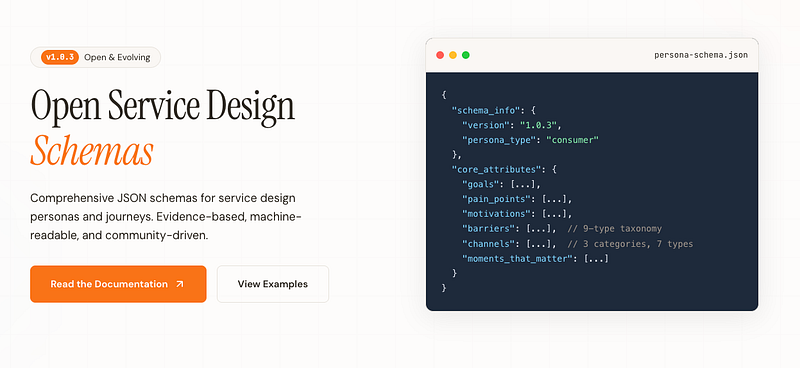
I know there are tools like Smaply and TheyDo that have made it easier to work with Personas and Journeys, but these are special tools that most stakeholders won’t use, and are yet another proprietary tool that you have to use. I wanted to build a standard format that I can use between my various tools and projects and saves me precious time.
As always, the quality of what you get out depends on the quality of what you put in. Having data standards for Personas and Journeys doesn’t remove the need for quality research and synthesis, or taking the time as a team or with stakeholders to really think through how a service should be designed, but this should make it easier to have the time to do that.
This is a work in progress, and I’ll be sharing more soon. I’m also working on plugins for Figma and Powerpoint to make it easy to import these into our common tools, but I’m keen to see how different people might pick these up and use them in their own tools and methods.
Maintaining our humanity
I’ve talked quite a bit about tooling, methods and even business stuff, but all that makes this final part even more important. We need to maintain our humanity and empathy.
As we get better at working alongside business, find tools for managing complexity, and find more efficient ways to work, all of this should be with the purpose for creating things that are better for people.
The widespread adoption of human centred design by a lot of organisations has hinged on the idea that if we identify a need and meet that need well, users will be happier, they will want to engage more in future, often in exchange for money.
But needs based design only focuses on one small slice of who we are as people. We’re not just a bunch of needs in a trench coat pretending to be people.
I originally came into design from a psychology background, with a big focus on how we can design experiences, services and organisations that enable human flourishing. How can we create a world where people can live happier, more engaged, social, healthier lives.
Let’s be honest, looking at the world around us it’s easy to say we’re missing the mark in a few big areas …
Focussing on Needs is a first step in getting organisations to think about how we can design for people, but much like taking a singular focus on profit, engagement or satisfaction, it gives us a blinkered view that can lead to unintended consequences, or even wilful blindness to known problems.
Social Media platforms can be a peak example of this. On one hand, they’re incredibly user focused. How can they make it as easy as possible for users to share content they want, to foster communities of like-minded people, and quickly disseminate viral content so many people can engage with it. But can it really be considered successful human centric design if you’re making it easier to share content that is biased, create isolationist communities that foster disagreements, and promote content that spike engagement through anger?
We need to think more expansively about what is healthy for people, what can foster human flourishing, and what that means for the things we’re putting into the world.
Over the last year, I’ve been rereading my psychology books, dipping into philosophy and sociology, and developed a set of principles that act as a check when I’m working on a solution. Not a scorecard where everything must be maximised, but a way of asking: what is this doing to people beyond meeting their immediate need?
My 11 principles (In no particular order):
Resilience : Does this help people adapt to difficulty and adversity, or does it create fragility or dependency?
Nature / Environment : Does this foster connection with nature and the environment, or distance people from it?
Mastery : Does this help people learn and develop skills, or does it do everything for them?
Creativity : Does this enable people to express themselves creatively, or does it constrain them?
Balancing reason and emotion : Does this help people balance reason and desire, or does it exploit one at the expense of the other?
Transcendence : Does this help people feel connected to something greater than themselves, or does it isolate them in the immediate?
Purpose : Does this support people’s sense of meaning and purpose, or does it reduce their engagement to transactions?
Fairness : Does this treat people fairly and without discrimination, or does it create or reinforce inequities?
Social connection : Does this foster genuine connection and compassion, or does it create isolation, superficiality, or division?
Safety : Does this help people feel and be safe, or does it introduce new risks or anxieties?
Autonomy : Does this give people influence and choice within their own lives, or does it remove agency?
When I’m evaluating a solution, I ask: how does this affect each of these areas? A service that meets a user’s immediate need but reduces their autonomy, isolates them from social connection, or creates dependency rather than mastery might be solving the wrong problem, or solving it in the wrong way.
Returning to social media: these platforms score well on meeting needs, but poorly on autonomy, on balancing reason and emotion, and on fostering genuine connection rather than division. That gap is what I want to avoid in my own work.
These four areas are interconnected. Better tools for complexity free up time for deeper understanding. Stronger business integration creates space for harder conversations about impact and accountability. And keeping human flourishing central ensures that as we evolve our practice, we’re evolving in a direction worth going.
I don’t have all the answers. The tools I’ve been building are experiments, and the principles I’ve shared will likely evolve as I apply them more widely. But I’m convinced that Service Design needs to become something more than what it is today, and I’d rather be actively exploring what that looks like than waiting for it to happen.
This isn’t a manifesto or a finished vision, and I’ll be sharing more about each of these areas over the coming months. This is an invitation to explore what Service Design could become. If you’re grappling with similar challenges, building your own tools, or simply want to push back on any of this, I’d genuinely welcome that conversation.