Paths to the future we want: Using Speculative Design and Future Cones to change paths
Recently, I’ve had multiple conversations about how designers can help people better consider the long-term impact of the decisions they’re…
Paths to the future we want: Using Speculative Design and Future Cones to change paths
Recently, I’ve had multiple conversations about how designers can help people better consider the long-term impact of the decisions they’re making today, and how you can develop and nurture solutions that can have a longer-term impact. I’ve found and developed some useful tools that might help navigate these sometimes complicated and ambiguous topics.
Designing for a better future
In the last year, many people have begun talking about how we’re facing Polycrisis, meaning “the simultaneous occurrence of several catastrophic events”. That’s not the future we want, but it’s the one we’ll get unless we create something better.
At its core, Design is about intentionally creating a future that doesn’t exist yet. We look at the current state. We try to understand the problems. We create something better (however you choose to define “better”…).
But using Design isn’t inherently going to lead to a transformational future state. Depending on the scope and constraints, design can often lead to iterative change. Change that just leads to a more refined or evolved version of what we already have. When misapplied, it can even reinforce existing problems.
This could be down to a number of different factors, and there are entire books written and still to be written by people with more knowledge and nuanced understanding than me on the flaws and biases of design.
In this post, I want to touch on 2 things that block us from delivering the impactful design work we need:
- When we don’t push ourselves to think beyond the day-to-day trends and expectations we have.
- When we create a shiny future vision, but don’t fully invest or plan how to get there
Future Cones
Our present hasn’t come about because of a sudden drastic change in the last year or two, and our future won’t be based purely on what we decide today and tomorrow. It’ll be based on the cumulative impact of decisions we make over time.
For example, let’s look at self-driving cars, often raised as an example of impending innovation. This has depended on a series of decisions and investments that created the right environment for self-driving cars to make sense. There are other decisions that could have led to a greater focus on public transport or on cycling.
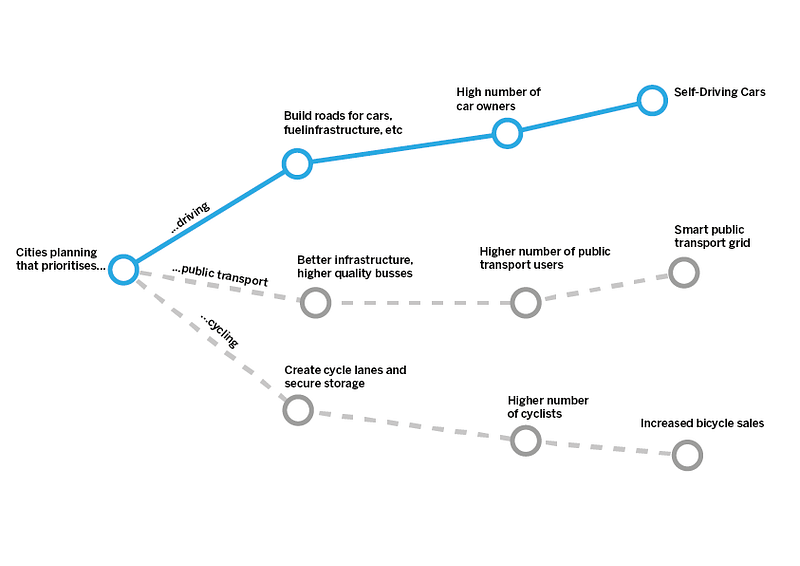 A simplistic mapping of decisions that contributed to self-driving cars being viable
Mapping these paths is a lot easier with the benefit of hindsight, it’s not so easy when looking into the future.
To help with this, Future Cones have been developed as a tool to help Future Casters articulate different futures, and how the future we want may differ from the future we’re likely to get.
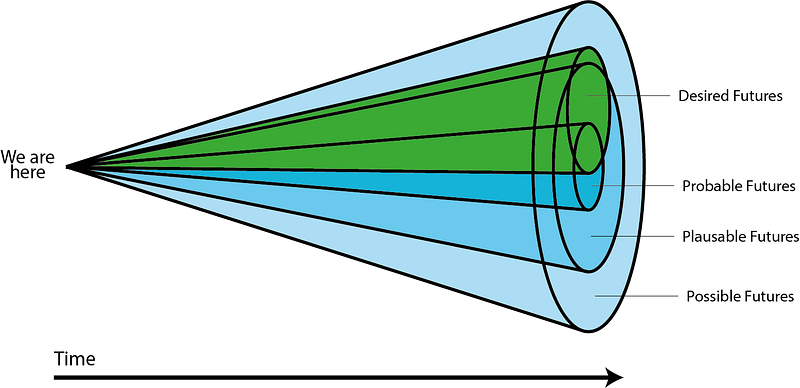 An example of future cones
This model categorises futures into seven main types, but I’ll focus on these four today.
- Probable Futures : This is what is “likely” to happen if we follow business as usual and work within the current trends, expectations, and constraints. Iterations on what we have without major change.
- Plausible Futures : These futures fall within the realm of what “could happen”. They rely on many of our current constraints but require us to think beyond and challenge the current trends.
- Possible Futures : These are futures that “might” happen. We need to expand our knowledge or develop new technologies to enable them.
- Desired Futures : This is the future that “should” happen. This cone overlaps with the others and describes the futures we want to see in the world.
As you can see on the right-hand side of the image, the Desired Future doesn’t fully overlap with the Probable Future cone. Just because we have an idea of what the future should be like, it doesn’t mean it’s the natural conclusion of the decisions and actions that have got us here.
If we can start making decisions today that can steer our path to move us toward the Desired Future, great!
However, there are two big factors you have to consider. The further the Desired Future deviates from the Probable Future, the harder it will be to change our path to reach it, and the longer we leave it the more it will deviate from the probable future.
To have a big impact, you can either plan a series of smaller changes over a longer period of time or do it more quickly it’ll take significantly more effort to make it happen.
Speculating to create a vision that challenges the norm
Before you can map and plan the route you want to take, you first need to have a vision of the future to aim for.
When facing major challenges, like climate change, we need to be able to think big about the future we want and the impact we want. If we stick to the probable path, then things will continue to get worse.
This is where Speculative Design plays a key role. It asks us to critically think about the forces and trends that are influencing our lives today and to speculate about how these could become more pronounced over time and have radically different impacts on our daily lives.
As well as helping us apply a critical lens to following the Probable Future path, we can use these tools to develop alternative futures and to think more radically about what the future could be like. Rather than speculating based on what forces we face today, what could it be like if we changed something? What if Universal Basic Income was introduced? What if we never manage to harness Nuclear Fusion for energy?
This helps us to challenge briefs or the expectations and constraints put on us. It can highlight the risks or problems that come from the cumulative impact of business as usual. We can push the boundaries and open up more radical conversations about what the future should look like based on the impact we want/need to have.
If a business wants to reach Net Zero in only five years (their impact goal), they should be thinking beyond just business as usual (Carbon offsets and efficiencies) and be pushing themselves to consider more radical options (building their own solar farms).
Removing barriers to the path
Once you have designed your future vision, there’s usually a very practical activity of looking for the enablers needed to make it happen and working backward to plan how to implement them.
For more radical change, I suggest that rather than jumping to enablers you begin by looking at the underlying barriers to change.
When people focus on enablers, they often reach for the things they already know and can apply; these are usually things that fall within the probable path. What can you add to an existing business to make it more sustainable? You can buy carbon offsets without changing much. You can reduce business travel fairly easily.
By focusing on the barriers, you can take a more considered approach to creating an environment that enables the future vision. Where can you reduce barriers that would usually block new ideas, or add friction to avoid getting stuck in business as usual?
For example, we recently did some work for a major retailer focussed on Diversity, Inclusion & Belonging, and how we could help them reach their ambitious vision for a truly diverse global workforce and leadership team.
We researched the barriers that individuals and the organisation faced when it came to hiring, developing, and promoting diverse talent. We then did a root cause analysis to find the underlying problems and barriers, including wider societal barriers.
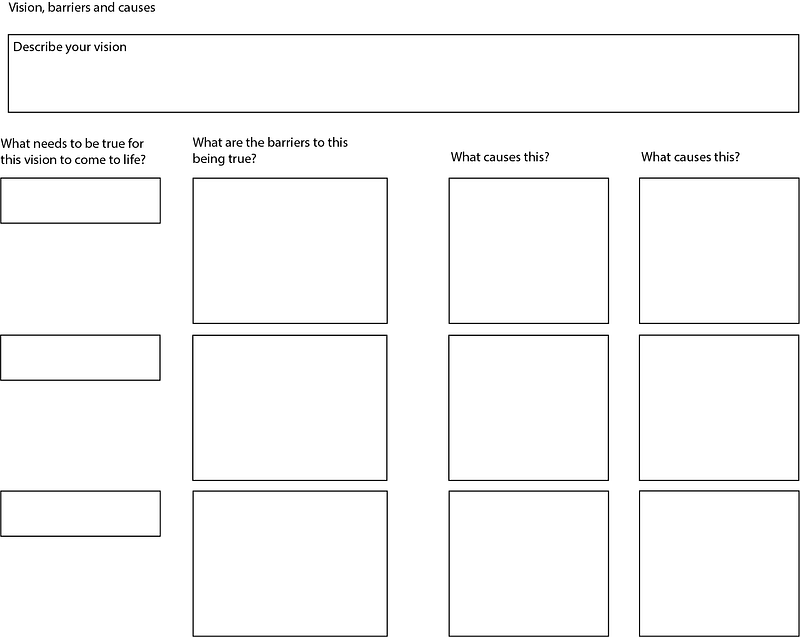 An example of a quick template for capturing barriers and root causes for a vision
Based on those, we could then develop creative ways to overcome those barriers. This moved the conversation from focusing just on things that just solve the immediate problem (e.g. diversity training, changing how they run interviews) to what actions they could take that could have a wider impact (e.g. working with colleges & universities for more accessible education opportunities, or making it easier to move from one area of the business so that progression paths aren’t limited to some parts of the organisation)
This can be done in tandem with identifying enablers and developing a roadmap or plan, but helps create an environment that nurtures and enables the Desired Future rather than just trying to create something in an environment that’s inhospitable to its success.
Designing for the future we want
In all design work we do, we should be thinking about the impact it will have and how we can play a role in creating a better world.
Climate change, healthcare, global inequality.
We’re facing a challenging, inhospitable probable future. We need to challenge expectations and identify practical, tangible ways to change our path toward the future we want.
If we don’t, we risk sleepwalking into a future we don’t want to be in.